What the Numbers Don't Tell You About Running a Business Right Now
There’s something going on which the headlines aren’t capturing.
On paper, we’re told things are stabilising. Inflation’s easing. Interest rates have settled. Employment rates are holding. The official story says we’ve weathered the storm.
But it’s not the story I’m hearing from business owners.
Over the past few months, I’ve noticed a pattern in nearly every conversation: a persistent, quiet pressure. Not panic. Not collapse. Something harder to name, a sense of doing everything right while running the business still feels harder than it should.
And these aren’t struggling businesses. They’re established. Capable. They survived COVID, absorbed cost increases, tightened operations, and kept moving forward.
So why hasn’t the tension lifted?
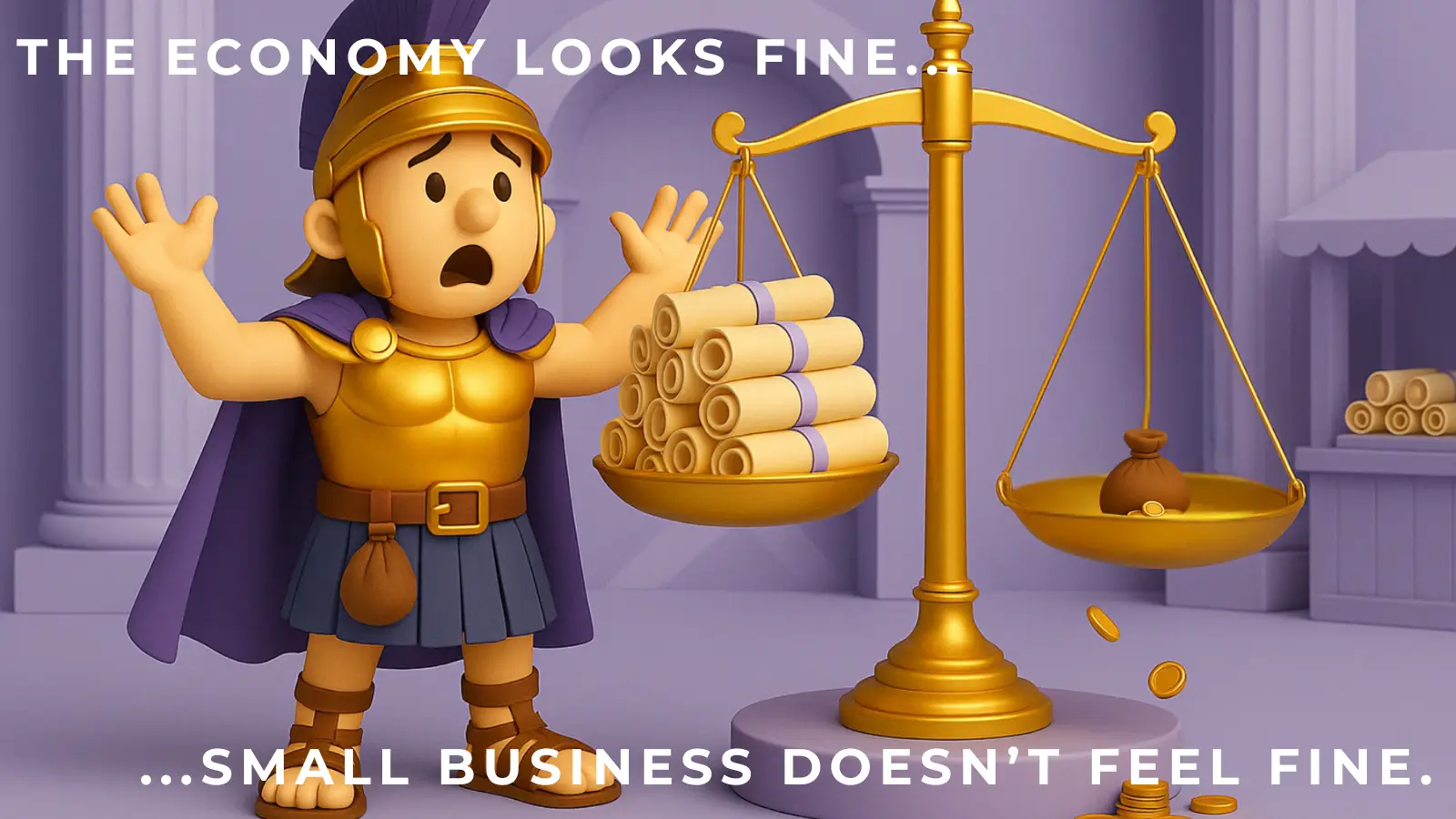
The disconnect between “the economy” and your business
The crucial aspect to know about economic data is it averages everything out. It smooths the peaks and valleys, focuses on broad trends, and paints a picture which works well for policy, but tells you nothing about what’s actually happening inside your business.
Fact: Small businesses feel economic pressure earlier than large ones. And they feel relief later.
When conditions tighten, big companies absorb the shock through layers of capital, pricing power, and time. Small businesses don’t have this buffer. They feel it immediately, in cashflow timing, customer behaviour, supplier terms, and the weight they carry home at night.
And when conditions improve? The recovery isn’t symmetrical. There’s a lag. And the lag is where the strain builds.
Small businesses feel economic pressure earlier than large ones. And they feel relief later.
What I’m actually seeing
The most common pattern I’m noticing isn’t dramatic failure. It’s erosion.
Decision fatigue. Mental load. Business owners carrying too much in their heads for too long.
Cash is coming in, but not predictably. Margins exist, but they’re fragile. Work is there, but it doesn’t translate into breathing room.
So you adapt. Planning horizons shorten. Decisions become reactive. The strategic work which “can wait” gets pushed out, not because it’s unimportant, but because there’s only so much bandwidth to go around.
This is where the public conversation about small business misses the mark.
Stress doesn’t usually come from a single bad decision or a lack of profit. It comes from uncertainty, from not knowing how tight things really are, or how much room you have to move.
The businesses coping better
The ones handling this period best aren’t necessarily the biggest or fastest-growing. They’re the ones with visibility. Not perfect certainty, it doesn’t exist. But enough clarity to reduce the guesswork. They know what’s coming up. They understand what’s fixed, what’s flexible, and what isn’t. They’ve created some space between today’s pressure and tomorrow’s decisions.
This doesn’t remove all risk. But it changes how the risk feels.
And more importantly, it means they can make decisions with confidence instead of stress, because they’re working from information, not instinct alone.
Why this matters as we move forward
We’ll likely continue to hear reassuring commentary about stability and recovery. And hopefully, over time, this does translate more evenly across the board.
But for many business owners right now, the reality is still about managing timing, pressure, and energy, not necessarily chasing growth headlines.
The disconnect between what the data says and what you’re experiencing isn’t imagined. And it’s not a failure of capability.
It’s a reminder of something simple: lived experience doesn’t move at the same pace as the narrative.
The businesses who navigate this period successfully won’t necessarily be the ones with the most revenue or the biggest teams. They’ll be the ones who know their numbers well enough to ride out the rough patches without losing sleep, and make sound decisions without second-guessing themselves.
It’s not glamorous. But right now, it matters more than almost anything else.
I’ll be watching closely to see how long this gap persists, and whether it begins to narrow as the year unfolds.
What are you noticing in your business right now? Drop a comment, I’d genuinely love to know if this matches what you’re seeing.