
You’ve worked tirelessly to build your wealth, but that constant worry lingers. The fear that business risks could threaten your family home, the frustration of seeing too much of your hard-earned money lost to tax, and the overwhelming complexity of planning for the future. You want to provide for your loved ones, but also ensure that legacy is managed wisely. If this sounds familiar, you’re not alone, and there is a powerful solution available to Australians known as a discretionary trust.
This guide is your first step towards lasting peace of mind. We’re going to strip away the confusing jargon and show you exactly how this structure can create a protective shield around your personal assets. You will discover how it can legally reduce your family’s overall tax bill and give you the flexibility to secure your children’s financial future on your own terms. It’s time to trade that financial anxiety for clarity and confidence.
Key Takeaways
- Discover how to create a protective shield around your family’s assets, keeping them safe from business creditors and legal claims.
- Learn how a discretionary trust gives you the control to legally minimise your family’s tax burden each year.
- Find out if this powerful strategy is the right fit for your specific situation, whether you’re running a business or planning for the future.
- A trust is not a DIY project; understand the essential steps and potential pitfalls to ensure it’s set up correctly for long-term success.
What is a Discretionary Trust? (The Simple Explanation)
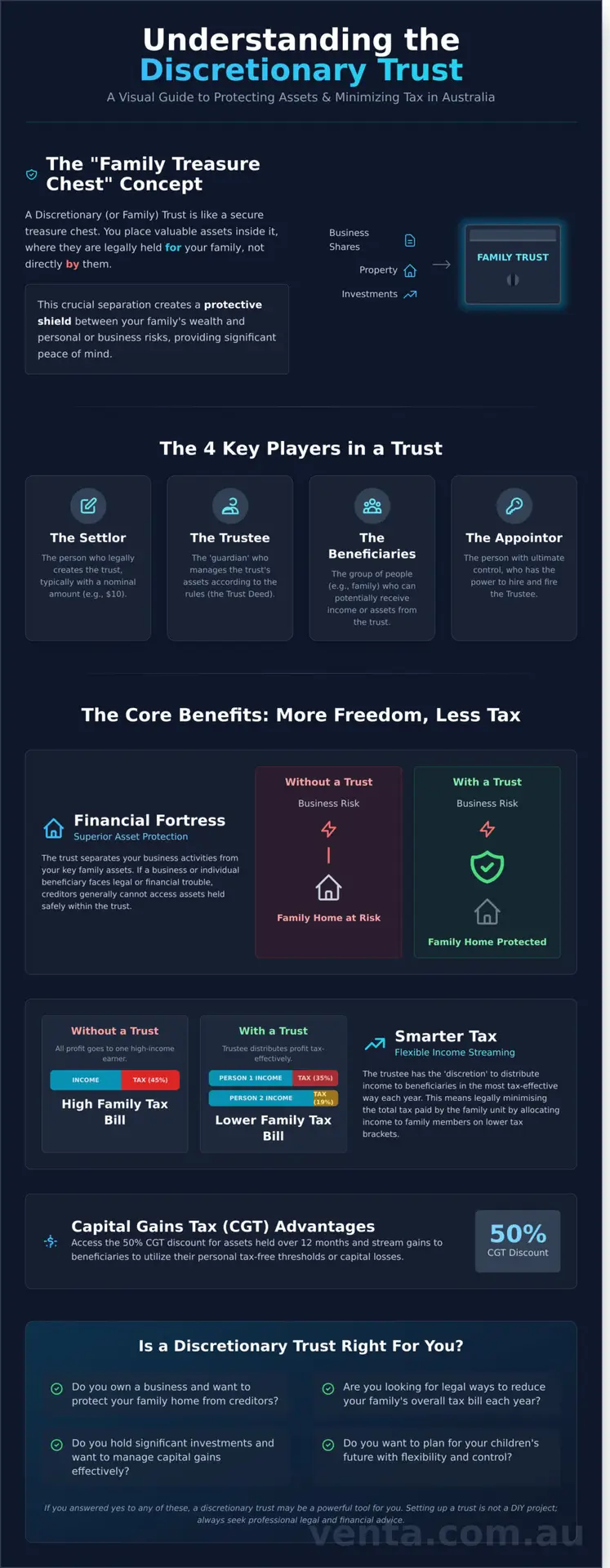
Forget the complex legal jargon for a moment. The easiest way to understand a discretionary trust is to think of it as a secure ‘family treasure chest’. The core idea is simple but powerful: assets like property, investments, or business shares are placed inside the chest, where they are held for your family, not directly by them. This creates a vital separation between your family’s wealth and your personal or business risks, giving you much-needed peace of mind. For a more technical overview, a Discretionary trust is a long-established legal structure, and it’s so popular in Australia for this very reason that it’s often simply called a ‘Family Trust’.
The Key Players Explained in Plain English
Every trust has four key roles. Understanding who does what is crucial to seeing how it protects your family and gives you control.
- The Settlor: This is the person who officially creates the trust, usually with a small nominal amount like A$10 to make it legally binding. Often, this role is filled by your accountant or lawyer to keep things independent.
- The Trustee: The ‘guardian’ of the treasure chest. The trustee manages the assets inside the trust according to a rulebook called the Trust Deed. This can be one or more individuals, or a company set up for the purpose.
- The Beneficiaries: The people who can potentially benefit from the assets in the trust. This is typically a wide group, including you, your partner, your children, and even other family members or related entities.
- The Appointor: This is the person with the ultimate power. The Appointor can hire and fire the Trustee, ensuring the person managing the assets always acts in the best interests of your family.
Why ‘Discretion’ is the Most Important Word
The real magic of this structure lies in its name. The Trustee has the ‘discretion’-the choice-to decide how to distribute any income or capital the trust generates each financial year. This means they can assess the family’s needs and individual tax situations and decide who gets what, and when. This isn’t about being random; it’s about being strategic. This flexibility is the key that unlocks powerful opportunities for effective tax planning and protecting your hard-earned assets from unexpected challenges.
The Core Benefits: More Freedom, Less Tax
You work hard to build your wealth, but the pressure of protecting it can feel overwhelming. A discretionary trust isn’t just a legal document; it’s a strategic tool designed to give you breathing room and greater financial control. Think of it as a cornerstone strategy to safeguard the assets you’ve built, ensuring your business success translates into lasting family security.
This powerful structure offers two main advantages that every business owner should understand: superior asset protection and significant tax efficiency. Let’s break down how it helps you keep more of what you earn and protect it for the long term.
Building a Financial Fortress: Superior Asset Protection
One of the greatest sources of anxiety for business owners is risk. A discretionary trust acts as a shield, legally separating your key assets from the individuals in your family. This means that if a beneficiary faces legal or financial trouble, the assets held within the trust-like your family home or investment portfolio-are generally protected from creditors. For company directors and professionals, this provides immense peace of mind, creating a financial fortress around what matters most.
Smarter Tax Planning: Income Streaming Explained
Flexibility is where this trust structure truly shines. The trustee has the ‘discretion’ to distribute income to various beneficiaries each financial year in the most tax-effective way. For example, instead of receiving all the business profits yourself and paying tax at the highest marginal rate, you could distribute a portion to an adult child at university with a lower income. This legally minimises the total tax paid by the family unit, helping you achieve your goal to “Pay Yourself More”.
Capital Gains Tax (CGT) Advantages
When it comes to selling assets like investment properties or shares, a trust offers powerful advantages. It can access the 50% general CGT discount for assets held for more than 12 months. Better still, the trustee can stream these capital gains to specific beneficiaries to make use of their personal tax-free thresholds or capital losses. This flexibility is a key reason why organisations like the Australian Shareholders’ Association highlight its benefits for managing investment portfolios effectively.
Is a Discretionary Trust Right for You? Common Scenarios
The term “trust fund” often brings to mind images of inherited fortunes, but the reality is far more practical. A discretionary trust isn’t just for the ultra-wealthy; it’s a powerful strategic tool that can provide security, flexibility, and breathing room for many Australians. It’s about building a structure that protects the future you’re working so hard for, not just managing the present you have.
If you recognise your own goals and worries in the scenarios below, it’s a strong sign that exploring a trust structure could be your next best move.
For the Business Owner
You pour your life into your business, but that dedication often comes with risk. A trust can act as a crucial firewall, separating your hard-earned personal assets (like your family home) from the liabilities and pressures of your business operations. This provides vital peace of mind, protecting your family’s wealth from potential business creditors and allowing you to plan for the future, such as bringing your children into the business and distributing profits flexibly.
Many successful Australian family businesses use these strategies to protect the legacy they’ve built. For a great example of a family-owned company that has built a strong brand from the ground up, you can check out Aussie Online Blinds.
For the Savvy Investor
As your portfolio of shares or investment properties grows, so does your tax bill. Managing this effectively is key to building real wealth. A trust provides a vehicle to hold these assets for the long-term benefit of your family. Critically, it gives you the flexibility each year to distribute investment income and capital gains to beneficiaries in lower tax brackets, helping you legally minimise your tax burden and reinvest more of your returns.
For Families Planning Their Legacy
You want to provide for your children or grandchildren, but you also want to ensure that support is protected and used wisely. A discretionary trust gives you control. If you’re concerned about a beneficiary’s relationship ending, their spending habits, or their vulnerability, the trust’s assets remain protected. It’s an adaptable estate planning tool that can evolve with your family’s needs, ensuring your legacy supports them in the way you intended for decades to come.
Potential Downsides and Common Pitfalls to Avoid
While a discretionary trust is an incredibly powerful tool for protecting your assets and managing tax, it’s not a ‘set and forget’ solution. Think of it less like a simple bank account and more like a vehicle that needs a skilled driver and regular maintenance. Understanding the potential complexities from the start is the key to avoiding future stress and ensuring your trust delivers the freedom you’re looking for.
Being aware of the potential risks isn’t about creating fear; it’s about giving you the clarity and confidence to make the right decision for you, your business, and your family. With the right advice, these challenges are easily navigated.
Understanding the Costs and Complexity
Setting up a trust properly is an investment. There are upfront legal costs for a professionally drafted trust deed, which is the foundational rulebook for your trust. Beyond this, you’ll have ongoing administrative costs, such as annual accounting and the preparation of a separate trust tax return. The rules for making distributions and ensuring compliance must be followed precisely each year, as mistakes can be costly and undermine the trust’s benefits.
Navigating the Risks: What Can Go Wrong?
It’s crucial to go in with your eyes open. When you transfer an asset into a trust, you give up direct personal ownership-the asset legally belongs to the trust. This shift can feel unsettling without the right mindset and structure. It’s also vital to consider:
- Potential for family disputes: Without clear communication and a well-defined plan, the flexibility of a trust can sometimes lead to disagreements among beneficiaries down the line.
- Land tax surcharges: In some Australian states, properties held within a trust may attract land tax surcharges or lose access to the tax-free threshold if not structured correctly.
- Loss of control: The trustee holds legal control of the assets. If you choose the wrong trustee, you could face serious challenges.
Choosing the Right Trustee is Critical
The trustee has significant legal duties and is responsible for managing the trust’s assets in the best interests of the beneficiaries. This is not a role to be taken lightly. Poor administration can lead to serious legal issues and financial chaos. For this reason, appointing a corporate trustee is often the recommended path for business owners. It provides superior asset protection, simplifies succession planning, and creates a clear, professional separation between personal and trust affairs.
Feeling overwhelmed? We can help you find clarity.
How to Set Up a Discretionary Trust: A 5-Step Overview
Creating a trust is a structured, deliberate process designed to give you security and control. It’s about building a robust foundation for your assets, not a task to be rushed or attempted on your own. Getting the structure of your discretionary trust right from day one is crucial for avoiding future headaches and ensuring it serves its purpose effectively.
Think of this overview as your roadmap, showing you the clear path from an idea to a fully functioning asset protection and wealth management tool. It all starts with getting the right advice for your unique situation.
Step 1: Get Expert Strategic Advice
Before any documents are drafted, the most critical step is to get strategic clarity. This is where you sit down with an expert advisor to discuss your goals. Are you looking to protect your family home, manage business assets, or create a flexible structure for future generations? We help you map out the key people-the Trustee, Beneficiaries, and Appointor-to ensure the structure is perfectly aligned with your ‘why’.
This principle of seeking specialized counsel applies to many of life’s complex undertakings. For families considering international opportunities, navigating the U.S. immigration system is another area where expert guidance is paramount; in these cases, a professional consultancy such as True Ventures, LLC can provide the necessary support.
Step 2 & 3: Legal Drafting and Settling
Once your strategy is clear, a lawyer will draft the Trust Deed. This is the official rulebook for your trust, outlining its powers, rules, and purpose. To legally bring the trust into existence, a ‘settlor’ (usually a third party, like your accountant or lawyer) provides an initial ‘settled sum’-typically a nominal amount like A$10. This formal act establishes the trust as a legal entity.
Step 4 & 5: Stamping, Registration, and Operation
With the Trust Deed created, the final steps make it operational. This involves a few key administrative tasks that turn the plan into a reality:
- Signing and Stamping: The trustee signs the deed, which is then stamped by the relevant state revenue office.
- Registration: You will apply for a Tax File Number (TFN) and an Australian Business Number (ABN) for the trust.
- Banking: A bank account is opened in the name of the trust. This is essential for keeping the trust’s assets separate and allows it to start operating.
While these steps provide a clear roadmap, the journey always begins with a strategic conversation. If you’re ready to explore how a structure like this can give you more control and freedom, our team is here to help.
Building Your Future: Is a Discretionary Trust the Right Foundation?
Navigating the world of trusts can feel complex, but the core ideas are about giving you control and protection. As you’ve seen, a discretionary trust is a powerful structure that offers incredible flexibility for protecting your assets and legally minimising your tax. It puts you in the driver’s seat, but it’s a strategic tool that must be tailored to your unique goals to avoid common pitfalls.
Understanding the ‘what’ is the first step. The real transformation comes from understanding the ‘why’-how the right structure can give you the breathing room and freedom you’re working so hard for. At Venta Belgarum, we help you understand the ‘why’, not just the ‘what’. Our strategies are designed to help you ‘Pay Yourself More’ by ensuring your assets serve your life, not the other way around.
If you’re ready to move from theory to action, we’re here to provide expert advice focused on your personal freedom and profit. Ready to build your financial fortress? Let’s talk about a strategy that gives you freedom. Taking control of your financial future starts today.
Frequently Asked Questions About Discretionary Trusts
How much does it cost to set up and run a discretionary trust in Australia?
Setting up a discretionary trust with professional legal and accounting advice typically costs between A$1,500 and A$3,000. This ensures the trust deed is tailored to your specific goals. Ongoing annual costs for accounting and tax return preparation usually start from A$1,000. Think of this not as a cost, but as an investment in protecting your assets, achieving tax flexibility, and securing your family’s financial future, giving you invaluable peace of mind.
Can I be the trustee and a beneficiary of my own family trust?
While you can be a beneficiary, it is generally not advisable to be the sole trustee and the sole beneficiary. This can risk the trust being legally invalid. For robust asset protection, it’s far better to have a separate trustee, such as a corporate trustee (a company you control) or another independent person. This separation is crucial for demonstrating that the assets are truly held by the trust, not by you personally, which is key to its protective power.
What happens to the assets in a discretionary trust during a divorce?
Navigating a separation is challenging, and finances add another layer of stress. It’s a common misconception that trust assets are automatically protected. The Family Court of Australia can, and often does, consider trust assets as part of the matrimonial property pool, especially if one partner has significant control over the trust. A well-structured trust can offer a layer of protection, but it is not guaranteed. Seeking expert legal advice is essential in these situations.
How long does a discretionary trust last in Australia?
In Australia, a discretionary trust cannot exist forever due to the “rule against perpetuities.” Most modern trust deeds specify a vesting date, which is typically 80 years from the date the trust was established. On this date, the trust ends, and the assets must be distributed to the beneficiaries. This long lifespan makes trusts an incredibly powerful tool for protecting and growing wealth across multiple generations, creating a lasting legacy for your family.
Who can be a beneficiary of a discretionary trust?
The beauty of a discretionary trust lies in its flexibility. The beneficiaries are usually defined as a wide class of people in the trust deed. This typically includes your immediate family (spouse, children, grandchildren), extended family members, and any companies or other trusts controlled by those family members. You can even include specific charities. This broad definition gives the trustee the freedom to distribute income and capital in the most effective way each year to support those who need it most.
Do you have to distribute all the income from a trust each year?
Yes, it is highly tax-effective to distribute all net income to beneficiaries each financial year. If a discretionary trust retains its income, it will be taxed at the highest marginal tax rate, which negates many of its benefits. The core strategy is to stream income to beneficiaries who are on lower personal tax brackets, such as an adult child at university or a non-working spouse. This strategic distribution is key to minimising the family’s overall tax burden.

Written by
Alexandra Bromham
Alexandra has spent years in top-tier tax advisory roles before starting Venta. But it wasn’t until she was running her own firm—while managing a team, a mortgage, and three kids under five—that the real cost of unclear finances hit home. That experience shaped our approach today: sharp, supportive, and seriously useful.
Disclaimer
“The information on this website is general in nature and is provided for information purposes only. It is not legal, financial or professional advice. You should obtain specific, independent advice relevant to your circumstances.”